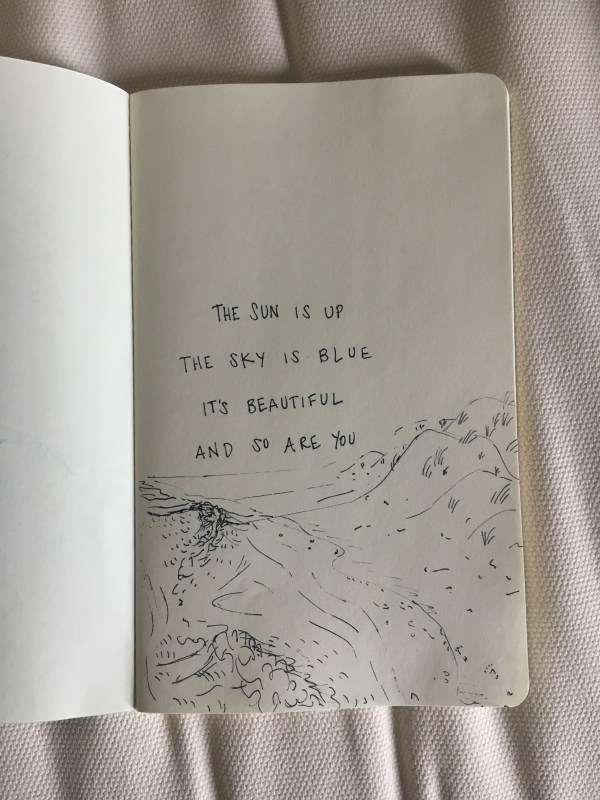
Care, by definition, is an interaction between two people when one is ill, incapacitated, overwhelmed, or otherwise in need. So as a friend and scholar once pointed out to me, self-care is an inherent contradiction, an oxymoron pointing to the theoretical impossibility of doing for oneself when one is weak.
However, anyone who has struggled with grief, trauma, mental illness, physical pain or discomfort, or the broad swath of conditions that fall under chronic and temporary forms of disability knows that caring for oneself is not only doable; it is necessary. As an anthropologist, here’s how I see it: ability is defined by “the system” (capitalism, white supremacy, patriarchy, and the other shapes that power takes in order to define which bodies are “able,” and thus worthy, and which are not). In order to survive within this inherently unfair and abusive system, we must cultivate love, contentedness, peacefulness, and resilience. To thrive in this way, even just to survive, is to contest the dominant regime that marks us as “less-than.” In the unforgettable mantra of Audre Lorde, “Caring for myself is not self-indulgence, it is self-preservation, and that is an act of political warfare.” Her declaration echoes the Black Panther Party aims of “self-preservation and self-determination.” In other words, self-care is a way of asserting that we will not go away. (But please, don’t misunderstand me: it also reckons with the question that without some form of defense our bodies, if not our spirits, might.)
For myself, self-care envelops several practices and points-of-view. First and foremost: I am enough. Yoga is a spiritual and physical practice that personally brings me lots of strength and peace, largely because it centers around the conception of the self as part of the celestial material, the body as part of the natural ebb and flow of the world, and the spirit as eternal and interconnected. One of my favorite breathing exercises encapsulates this foundational truth: you simply inhale and tell yourself, I am. Then you exhale and tell yourself, “[ _____ ] enough.” In New York City in the dead of winter, more depressed than I have been in years, I lay on the floor of my tiny studio and listened to the steampipes bang and whistle and told myself, I am smart enough to do this work, I am strong enough to survive this pain, I am loved enough to do anything, I am enough, I am enough, I am enough. It’s been two years since then, and even though I’m earning my PhD and managing my mental and physical and health and couldn’t do any of that without my beloved partner, friends, and family—I still have to remind myself. Recently, my dear friend, Lauren Broussard, co-presented on a panel with sociologist and civil rights activist Dorothy Roberts, and she asked the esteemed scholar what advice she would give to her younger self. She said, “That I am enough. I was always enough.” You are enough, too.
A second important component of my personal approach to self-care is somewhat more literary: like Whitman, I believe I contain multitudes; like Woolf, my voices are split into a cast of characters rich and poor, feminine and masculine, old and new; like Hurston, “I love myself when I am laughing, and then again when I am looking mean and impressive.” I don’t see my self as a necessarily bound or singular entity, but more like a chorus of voices or a collection of atoms that come together into molecules and then materials. In this way, I think we can answer the paradox of caring for oneself because the self is not isolated or individual; rather, it is multiple and interconnected.
The light in me recognizes the light in you.
 skeptiki