There is a darker side to this self-care story. Though I ended part i on an empowering note—Lorde quotes and all—I also struggle with the idea and practice of self-care for a few reasons.
First and most Foucauldian, self-care is a way of managing the individual self instead of addressing the social, political, and economic determinants driving poor health. Medical anthropologists frequently use this idea of employing “technologies of the self” to interpret how “prevention as treatment” regimes engage in rhetoric of personal responsibility around health management. My friend and mentor Matt Thomann researches how the medicalization of HIV prevention is taking a side-step away from “safe sex” messages (although they’re in there, don’t worry) and instead seeking out implant opportunities to ensure compliance. You can see a parallel trend in birth control as more women opt for LARCs like Norplant and the IUD. In an even more public way, these practices have been mainstreamed by the emergence and popularity of health-tracking devices, like the FitBit. I did a two-week auto-ethnography of using my FitBit, and while I was certainly getting more exercise over the time period I also began to check for points and log additional data compulsively. The major underlying problem with all of these trends in health and medicine is that they transfer the burden of ensuring good health away from the state or even the healthcare provider and onto the individual “consumer.” The economic language undergirding public health debates over preventive health technologies and the shifting onus of care demonstrates that such transformations benefit the system—again, white supremacist/cis-heteronormative/patriarchal/colonial capitalism—and not the individuals or populations whose health is in question. As always, when you consider the disproportionate effects of health disparities, this means the behavior of marginalized people become particular targets for intervention. For example, it is widely known that prevalence of diabetes is high in many urban and rural low-income communities of color due to structural issues around food deserts and preventive healthcare access; however, the health behavior model that predominates in public health today aim to change “unhealthy” behavior using “culturally competent” models for shifting norms and strengthening self-efficacy. This is all a fancy way of saying: Big Healthcare is trying to make money off of your illness and tell you it’s your fault, too.
Many of my personal self-care practices fall into this part-of-why-the-system-works realm: taking my medications and probiotics daily, sticking to an odd and restrictive diet, tracking my meals and symptoms (when I actually do it…), and restorative exercise when I can. I basically exert the majority of my energy preparing my body and morale for the minority of the time when I need to be present and functional. As a student, I’m extremely lucky—I think I would have needed to take leave from a 9-5 job. Even still I struggle to maintain my reduced schedule, fulfill work expectations, and care for myself. If one element of my anxiety or diet management falls out of pace, my entire week snowballs into pain, late work, and lack of productivity. The immense onus of this responsibility itself makes me anxious. I recently had to show up for a friend in need and left my comfort zone in the process; I literally could not have traveled to be there for her without all the support from my closest family and friends. And, while I’m learning to embrace that kind of community, even those interactions were emotionally and physically taxing… I hate that it’s another burden on me and the people who love me, dealing with this incapacity and its management on top of everything else. The food restrictions also limit my social life: I generally have to eat or prepare my meals at home (which takes foresight, another practice in the making…) and I almost always eat my sad chicken-and-rice nonsense alone. Finally, in spite of all this effort to feed myself without hurting, anxiety is the single biggest trigger that sets me back in terms of symptoms—I ate pizza one ambitious day while testing, and that was nothing compared to the morning of my first-ever conference presentation. As an acquaintance/online friend of mine who was at the mass shooting in Las Vegas recently joked, “let the nervous poops begin!” I’ve come to terms with a lot of the baggage of this embodied distress, but norms around femininity, asking about health, and personal privacy still trip me up. I admire Marissa’s direct hilarity; life is ridiculous, and sometimes you have embarrassing and debilitating shitting problems. Trying to let myself laugh about it more, because sometimes that’s really all you can do about it.
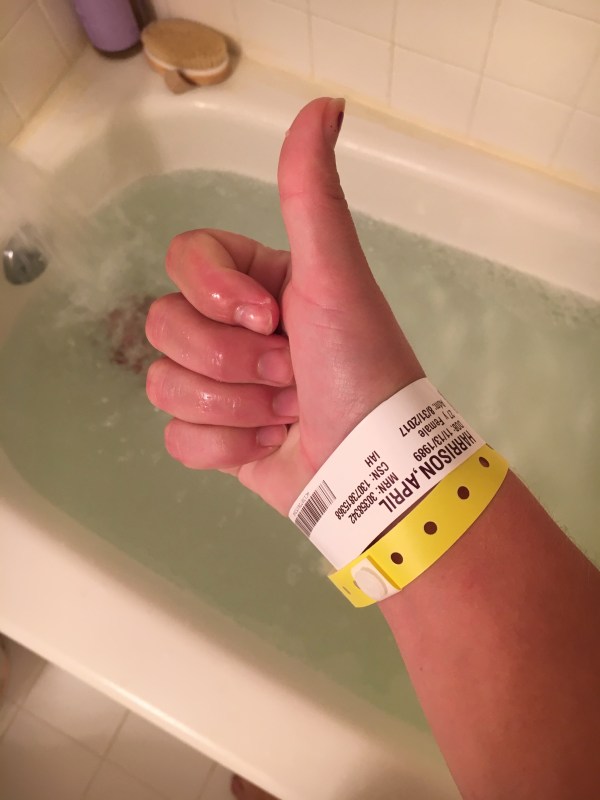
[Photo from the first thing I did when I got home from the hospital. Links from this post, in order:
“From a global crisis to the ‘end of AIDS: New epidemics of signification” by Kenworthy, Thomann, & Parker (2017) (requires scholarly access)
“‘WTF is PrEP?’ Attitudes toward pre-exposure prophylaxis among men who have sex with men and transgender women in New York City” by Thomann, Grosso, Zapata, & Chiasson (2017) (requires scholarly access)
 skeptiki