You might be sick of my questions by now–I was starting to feel the same myself, like do I really need a rhetorical question to anchor every post I write? But I decided that part of the reason I chose such a hesitant refrain was to emphasize my curious and humble approach to knowledge and my tendency as a woman to end my thoughts in question marks. (It wasn’t always this way, so please allow me to explain why, as well.)
First, I was forced to write for school, as part of the grand vision for a state full of children who could express themselves verbally. (Because of backwards cuts in education funding and teacher pay, North Carolina still struggles to educate its students to this level. Go red for ed!) For two years, our curricula bent toward the potent magnetism of the Fourth Grade Writing Test. My mother had just bought a desktop computer for her office in our house, which she used to do our taxes and pay our bills and I used to write stories and make flyers for fake events. So I practiced in that time: “It was a dark and stormy night…” I learned about the pitfalls of cliche phrases and imagery through my own frustrations at how to start a story. Was weather my only option? And did it have to be bad?
When the time came to write three paragraphs on an unknown prompt, I was obnoxiously ready. I unsheathed my .5 millimeter lead pencil and raised it for action. The teacher watched the second hand of the clock at the front of the classroom while the vice principal proctored, lurking out of our vision behind us. When the tension broke, I pulled open the packet and read: describe a day with your favorite character from a book.
Looking back, a key flaw of this question was that you also had to read. Because I was precocious and obsessed with teacher approval, I had already been reading several chapter books at this point because they gave you the most points on AcceleratedReader, the computer program that tested our literary comprehension for each book and gave us annual credit that transformed into boomboxes and Walmart gift cards by June. My mother had given me Harry Potter a few years before and then her family took us to London with them, so I was obsessed with the cast at Hogwarts. I could see that my peers would write something about the Berenstein Bears or Mrs. Frizzle–though honestly, I would love to read those essays still today–so I chose that dark and stormy wildcard, and spent my day with Moaning Myrtle. I was one of two kids in the whole school that passed; everyone had to retake it a month later.
But that’s not why I write, that’s more how I realized I was good at it. By accident, but knowing it made sense since I did it for fun. That fun turned quickly to obligation when my mother died.
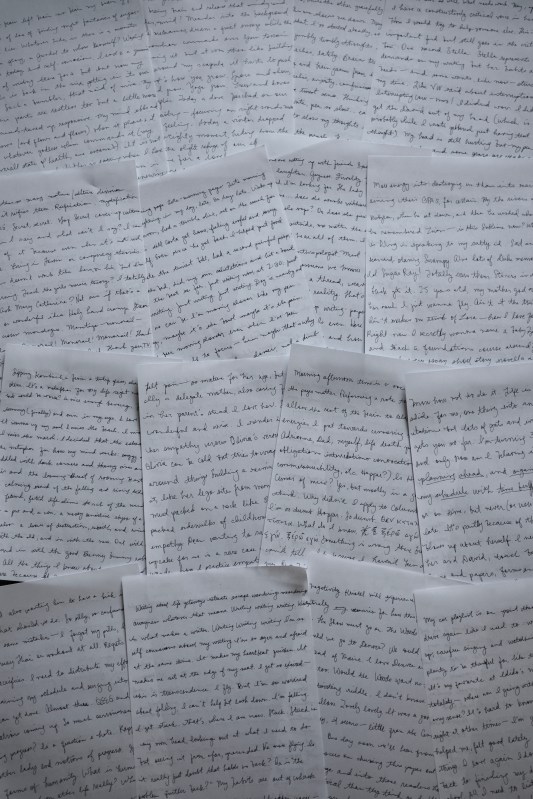
The first sentence I ever wrote in my journals was, “I didn’t cry so much in Durham as I did today, being home with the terrifying thought of Mommy not coming back… ever.” I keep that journal still today, writing now in the second person toward the space where my guardian should be in my life. I read an article about losing a mother as an adult that nearly cleaved my heart around the words, “losing a mother as an adult is harder than losing her younger because you still have your memories together.” Whereas I wrote to my dead mother at age twenty, “I miss you like it was just yesterday, only worse because it’s been so much longer that even my precious memories are leaving me.” It isn’t a blessed ignorance, it is a secondary loss. I wrote to her and about her to protect her memory against that second death, as much as I could. To pick up the scattered pieces of the most important woman in my life, who I had loved deeply but never really known.
I realized early on that I would have to reconstitute an image of who my mother was for myself, because I had barely known her as her own person.
 skeptiki