It’s a vital question: where are my roots? How was I raised? What was my environment? What was my role in it? Am I connected to these parts of myself still?
I think through these nesting-doll questions often. Sometimes I feel like the ecosystem I inhabited and the social life that shaped me are vital to understanding my complete personhood; other times I’m ready to shed those pieces of my past and disposition like so many layers of molted skin. Surely this isn’t a unique experience… but I can’t stop from flooding with angst most of the time when I think of that slippery concept, home.
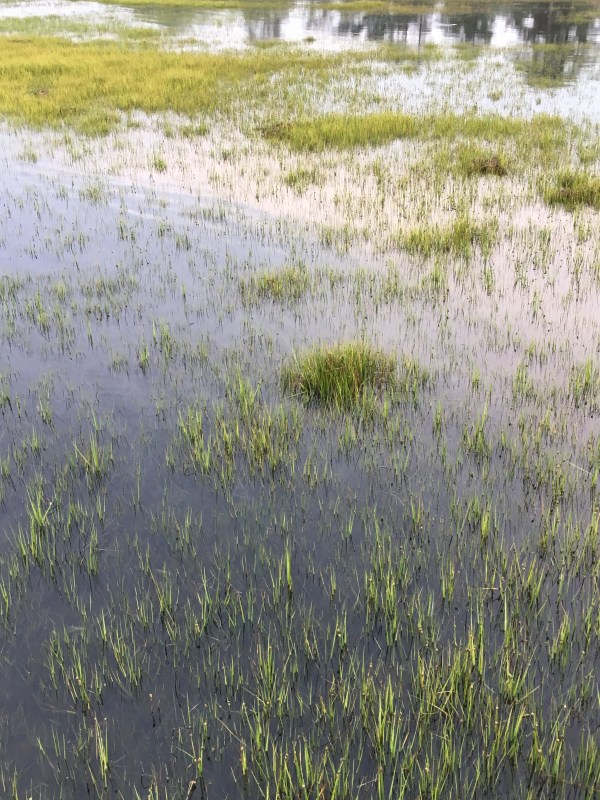
When I meditate, the safe space that I inhabit in my mind is the end of the dock of my childhood home. I wasn’t born to this residence but I spent my most formative years there, including the liminal grief of adolescence and loss. I wrote essays about fearing my father’s footsteps above me, titled The Monster Upstairs, which I hoped alluded to the mental health problems I was experiencing in the attic, so to speak. When I was afraid of that unhappy thunder or overwhelmed by tsunamis of tears for my dead mother, I would trade the putrid reek of loneliness in our stuffed up, spider-webbed house for the fetid stench of marsh pluff as it churned tiny tragedies into an estuarine lifesource. I would run down the wooden planks in any weather, but in my memory it is always raining, about to rain, or has just rained beforehand. The sky is clouded dark but the sun is straining strong behind the woolly weather. The water matches the sky’s tones of gray like a mirror, a perfect reflection distorted by small impressionist’s strokes as the tide comes in. It’s always coming in. The thick promise of continuity, of abstracted contented bliss, hangs in the wet air, daubing my skin with its own tears. I stand at the end of the dock, looking out to the waters, away from the endless horizon of the ocean, at the watery ellipsis separating my island from the rest of the world as I understood it then. The sun is setting behind the dunes and sand bars of the sound, behind the streetlights of the mainland, and I stay in the dusky ritual until I see the ibises rook up safely for the night, until I hear the owl pierce into its piece of twilight…
This is my home, both symbolic and visceral, in its most literal sense for me. My bedroom doesn’t offer me so much sanctuary as this spot in my mind, in my memory, in my hometown. This peaceful, if imperfect, image is the epitome of contentedness and tranquility for me. But what about the rest?
What about the rest… the way that insularity defines socialization in an island town, where you’re just as likely to have someone rehash the details of the latest opioid-related birth, death, or imprisonment as compliment your shoes at a holiday party. Everyone knows each other’s sexual habits, in large part because so many of us have shared partners over the decades of knowing (and “knowing”) each other. The shape of the island influences its social ecology, too; oblong and narrow, stretching from east to west instead of north to south like the rest of the barrier island chain. One major road, highway 24, connects the different hamlets that constitute the collective Bogue Banks. The towns themselves have more magical names: Atlantic Beach, Indian Beach, Pine Knoll Shores, Salter Path, Emerald Isle. Before you cross the bridge, tax funds are used to collectively rebrand the entire area as the Crystal Coast.
The metaphorical foundations of our provincial rhetoric was very clearly connected to these loving (if political) descriptions of the land: subdivisions took on charming epithets like Land’s End and Ocean Oaks, shopping centers like the Emerald Plantation evoked a confused local history, and most of the multi-family rental beach houses on Ocean Drive were named with brightly painted puns about sand, shells, pelicans, and free time. More inland, the touristic gaze encounters the less euphonic and more historicized VFW Road, Maysville, Newport, and Peletier. The twin port cities of Morehead and Beaufort hold more residuals of an almost mythical past, full of pirates and sunken ships and U-boats and Civil War forts and disappeared colonies. The privateer Otway Burns (namesake of the easternmost town in my county) found his final resting place in Beaufort’s centuries-old cemetery; legend has it that he is buried standing up and facing East toward the Atlantic, so as not to be caught unawares. Spanish moss hangs over lichen-covered headstones in this tiny but heavy spiritual site. Tucked in the corner behind the church, a small tomb stands about a foot high and three feet long, inscribed with a loving dedication to someone’s young daughter. No one has ever explained to me exactly why, but this particular child’s tomb is always decorated with trinkets left by visitors and passerbys: small turtle figurines made of pooka shells, plastic toy shovels, fake pink daisies, a polymer chain of pearls, my Little Pony, whatever toy is most recently distributed in a McDonald’s happy meal… I couldn’t tell you who this little girl was, but we all still mourn her loss and are sure to mark her grave with love before we leave.
The drugs are hard to discuss. This is a common tale for “rural America” these days, that imaginary conglomerate of all the spaces and places between urban points of interest. My friends have died, and everyone from my home knows someone who has died too. I don’t live there anymore so each new death makes my separation from the place a little more complicated and surreal: it’s not the place I remember, it’s not the end of the dock where I find solace in my mind. The violence is hard to swallow alongside the beauty and the love—but when I look back, with my new anthropologized lenses, it was there all along and has only recently found its expression tied to this broader chemical phenomenon. It was there in the marsh grass, swimming alongside the dolphins, crashing waves into sand and abrading the shore piece by piece, moment by moment, until what’s left reminds you more of what’s missing than what’s there.
The sickness is even harder to describe—it evades me. The story I’ve been reaching toward my whole life is driven by the widespread, seemingly inexplicable, random yet patterned, unifying yet alienating experience of disease. Before I was ten I was learning about neurological disorders I could barely pronounce, like amyotrophic lateral sclerosis. My brother was one of several of his age to experience childhood cancer, most commonly expressed as leukemia. My grandmother and my mother both died of brain tumors, and through the fact of those losses we became connected to an entire web of families affected by advanced stage glioblastomas. Most of the sufferers themselves are dead now.
Lately, this immuno-vulnerability has manifested itself in more unsettling, close to home ways. My friends and friends of friends from the area have been developing autoimmune disorders early in life, including early-onset arthiritis, swollen lymph nodes, lymphoma, digestive disorders and Crohns, endocrinological imbalances, and possibly malignant thyroid growths. We are all in our 20s and 30s. On top of these unmeasured rates of chronic pain, young people and especially young men are more likely to die in accident-related deaths, including suicide, homicide, and injury. Only two years after I moved away from North Carolina, the youngest son of family friends died because of medical negligence being treated for a concussion after a skateboarding fall. In an unspoken solidarity like our affection for the young girl buried centuries ago in Beaufort, the community came together to donate to the family’s scholarship fund and preventive education program to ensure that emergency medical technicians are warned about this boy’s cause of death, forcible intubation into his esophagus instead of his trachea. A group of forty or so people held a “surf-out” ceremony for their teenage friend, captured on their boards in the shape of a heart as they read dedications to someone whose death could—and should—have been avoided.
There’s hope in that—there’s life-force in that decaying tangle of social death and literal morbidity and mortality. There’s a people who want to make the world better for their children. The question we seem to fundamentally disagree on is, how.
 skeptiki